

Monesize Core was built around a straightforward idea: mid-market businesses should not have to manage their finance and operations as disconnected parts of the business.
As businesses grow, that separation becomes expensive. Sales generate financial records. Purchases create liabilities. Inventory affects costs and availability. Payroll creates expenses and statutory obligations. And when a business operates across currencies or jurisdictions, the financial picture becomes harder still to maintain accurately.
Monesize Core v2 takes that original proposition considerably further. The focus is no longer limited to one market. The platform is expanding to support mid-market and enterprise businesses operating across currencies, locations, and regulatory environments, while continuing to connect finance and operations in one place.
Here is what that looks like in practice.
UK HMRC Production Approval
For UK businesses, one of the most significant parts of Monesize Core has always been its direct connection to HM Revenue and Customs for Making Tax Digital for VAT.
The HMRC module allows eligible businesses to connect their HMRC account, retrieve VAT obligations, prepare VAT returns, make adjustments, and submit VAT information through HMRC’s digital interfaces. Critically, the VAT information comes from the financial activity already recorded in the platform. Sales, purchases, expenses, and other relevant transactions provide the underlying records used to prepare the VAT return, reducing the need for finance teams to reconstruct their VAT position separately from the records they already maintain.
That integration has now moved beyond development and testing into production approval. For UK businesses required to follow Making Tax Digital, this is not a minor milestone. Compliance is not an optional addition to finance software. It is a practical requirement of running the finance function, and Monesize Core now has a real production pathway to meet it.
The UK HMRC implementation also becomes the first authority within a broader tax framework that extends as Monesize Core expands internationally.
Multi-Currency Accounting
Businesses do not always operate in the currency in which they keep their books.
A UK business may invoice a customer in US dollars, pay a supplier in euros, and maintain its accounting records in pounds sterling. A business expanding into multiple countries may face the same complexity across dozens or hundreds of transactions every month.
Monesize Core v2 introduces multi-currency accounting so that transactions can be recorded in their original currency while still being incorporated correctly into the company’s base-currency financial records. Every supported transaction retains its transaction currency, exchange rate, and corresponding base-currency value. The original transaction remains visible in the currency in which the business actually dealt, while financial reporting continues in the company’s functional currency.
The multi-currency support extends through the full transaction lifecycle. When a foreign-currency invoice or bill is eventually settled, the amount received or paid can differ from the original base-currency value due to exchange rate movement or bank charges. Monesize Core captures those differences as foreign exchange gains or losses and records bank charges separately.
For UK VAT reporting, relevant values are converted into sterling at the transaction level, so multi-currency transactions continue to feed correctly into the VAT return.
This is not a currency selector on an invoice. It is multi-currency accounting that works through the transaction, settlement, and reporting process.
A Broader Tax Framework
Supporting multiple countries requires more than adjusting a tax rate.
Different jurisdictions have different tax types, return formats, reporting periods, filing requirements, and regulatory authorities. A business operating in the UK does not prepare its taxes in the same way as one operating in the United States, Canada, Ireland, or Australia.
Monesize Core v2 therefore expands its tax capabilities around jurisdictions rather than treating taxation as a single country-specific feature. The platform’s tax framework can define the tax types applicable to a jurisdiction, the structure of its returns, the rules used to aggregate financial activity, filing frequencies, and the authority responsible for the jurisdiction.
The UK HMRC implementation is the first within this approach. Additional jurisdictions build on the same underlying financial records, adapting the compliance experience to the country in which the business operates without requiring an entirely different finance platform.
A Proprietary US Sales Tax Engine
The United States presents a different tax challenge from the UK. Sales tax can vary by state, businesses need to consider where they have tax obligations, customers may have exemptions, and the tax treatment of products can differ between jurisdictions.
Monesize Core v2 addresses this with a native US sales tax engine, built into the platform rather than dependent on an external tax provider.
The engine is designed around state-level tax rates, seller nexus states, customer exemptions, and product-category exemptions. For a US customer, Monesize Core can identify the customer’s state, check the seller’s configured nexus states, determine whether the customer is exempt, apply any relevant product-category exemptions, and calculate the applicable tax before the sale or invoice is confirmed. The resulting tax information is retained with the transaction.
The platform also tracks tax liability by state and period, giving finance teams a view of taxable sales, tax collected, and transaction counts across their relevant states.
The initial scope focuses on state-level taxation. County and city-level taxes, automated state filing, and economic nexus threshold tracking are outside this initial release. The more important point is that tax calculation is part of Monesize Core itself, rather than requiring a separate product running alongside it.
E-Invoicing as a Native Capability
Invoices are increasingly more than documents that people read. In many markets, businesses are expected to exchange invoices in structured electronic formats that can be processed directly by accounting and government systems.
Monesize Core v2 introduces structured electronic invoicing using UBL 2.1, with invoices conforming to the Peppol BIS Billing 3.0 profile. This allows an invoice generated from Monesize Core to carry structured information about the supplier, customer, invoice number, dates, currency, tax, totals, and individual line items.
The capability also extends to Factur-X and ZUGFeRD, where structured XML is embedded inside a PDF/A-3 document. The result is an invoice that remains readable to people while containing machine-readable data that accounting systems and regulatory infrastructure can process directly.
As Monesize Core expands internationally, this becomes increasingly significant. Different markets are introducing or expanding electronic invoicing requirements, and businesses need to exchange invoices in formats that downstream systems can consume. Monesize Core treats e-invoicing as part of the invoice itself rather than a separate conversion step. The initial capability focuses on producing and validating compliant electronic invoice documents, with direct Peppol network transmission available as a later addition.
Supporting Documents Belong With the Transaction
Financial records rarely exist on their own. An expense has a receipt. A purchase may have a purchase order and delivery note. A bill has a supplier invoice. An asset may have warranty documentation. A sales invoice may have supporting materials attached to it.
Monesize Core v2 brings those documents directly into the records they support. Users can attach receipts, documents, and images to expenses, purchases, bills, invoices, sales, and assets, making supporting documentation part of the financial record rather than something maintained in a separate folder or document repository.
For finance teams, opening a transaction also means accessing the evidence behind it. The financial record and the documentation supporting it stay connected.
Business Configuration Built Into the Platform
As businesses grow, their finance requirements become more specific to the organization itself.
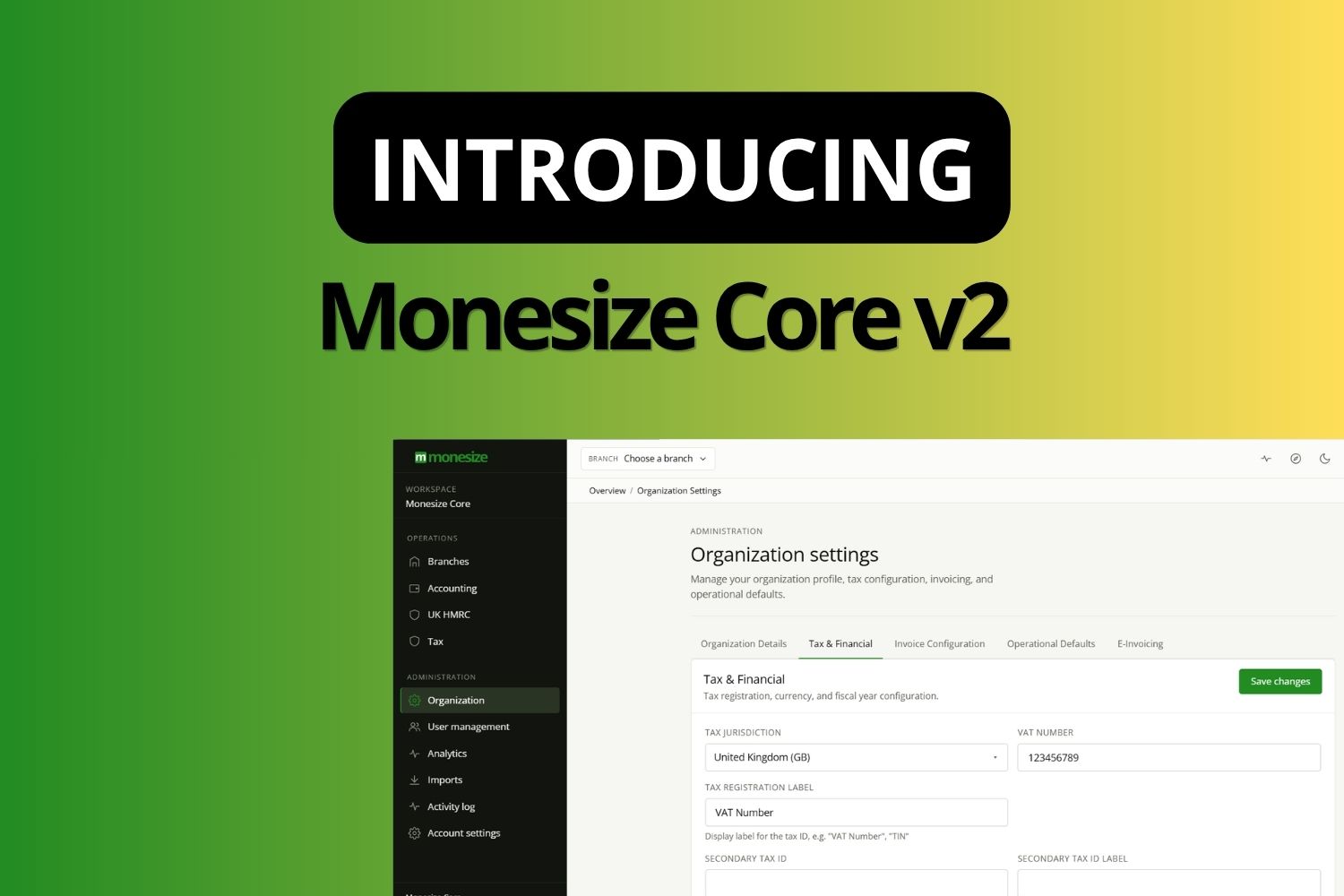
Monesize Core v2 expands organization-level settings so businesses can maintain their legal name, trading name, company registration number, registered address, tax registration number, tax jurisdiction, base currency, fiscal year, and invoice configuration directly within the platform.
Invoice configuration can include the company’s registration information, VAT registration number, address, payment instructions, invoice prefix, logo, and other business details. This gives businesses direct control over how their financial records and customer-facing documents represent the organization, which becomes increasingly important as the platform supports businesses operating across different countries with different registration numbers, tax identifiers, and currencies.
Payroll Integration Without Becoming a Payroll Provider
Payroll sits at the intersection of finance and operations, but building a specialist payroll product for every jurisdiction is not the direction Monesize Core is taking.
Instead, the platform is being extended to work with the payroll providers businesses already use, including Gusto, Deel, Rippling, and ADP, alongside a manual payroll option. Employee information and completed payroll runs can be brought into Monesize Core while retaining the detailed statutory breakdown supplied by the payroll provider.
That breakdown can include employee and employer National Insurance, income tax, pension contributions, student loans, and other statutory deductions. Rather than recording payroll as a simple gross-to-net transaction, Monesize Core can represent the different salary expenses and statutory liabilities a payroll run generates. Salary expense, employer contributions, tax liabilities, pension liabilities, and the actual cash payment flow into the accounting records separately.
Businesses keep their specialist payroll relationships. The financial results of those payroll runs come into the same platform as the rest of their business activity.
Canada, Ireland, and Australia
The international expansion extends further than the United States.
Monesize Core v2 adds a CRA capability for Canada, supporting GST and HST reporting with the relevant return structure, Canadian business information, and provincial considerations. Ireland follows with support for Revenue requirements, including Irish VAT and the VAT3 return. Australia is included through an ATO capability supporting GST and the Business Activity Statement.
Each addition brings its own compliance requirements into the same platform rather than requiring businesses entering a new market to move to a different finance product.
One Platform for Businesses Operating Across Markets
Taken individually, multi-currency accounting, jurisdiction-specific tax capabilities, structured e-invoicing, payroll integrations, and regulatory connections to HMRC, the IRS framework, CRA, Revenue, and ATO are each substantial additions.
Together, they change what Monesize Core can support.
A business can sell in one currency while accounting in another. It can maintain invoices with the correct company and tax information for its jurisdiction. It can keep receipts and supporting documents alongside transactions. It can calculate US sales tax where applicable. It can prepare UK VAT information directly through HMRC. It can generate structured electronic invoices. It can bring payroll information from an external provider into its financial records. And as the business enters another market, the platform adds the relevant tax and regulatory requirements without forcing a move to an entirely different product.
That is the direction behind Monesize Core v2. Not simply more features added to an existing product, but an expansion of what the platform can represent, calculate, and manage as the businesses using it become more complex.
Mid-market businesses operating across markets deserve a finance platform that moves with them. Monesize Core v2 is being built to do exactly that.
Ready to see what Monesize Core v2 can do for your business? Visit monesize.com to learn more.